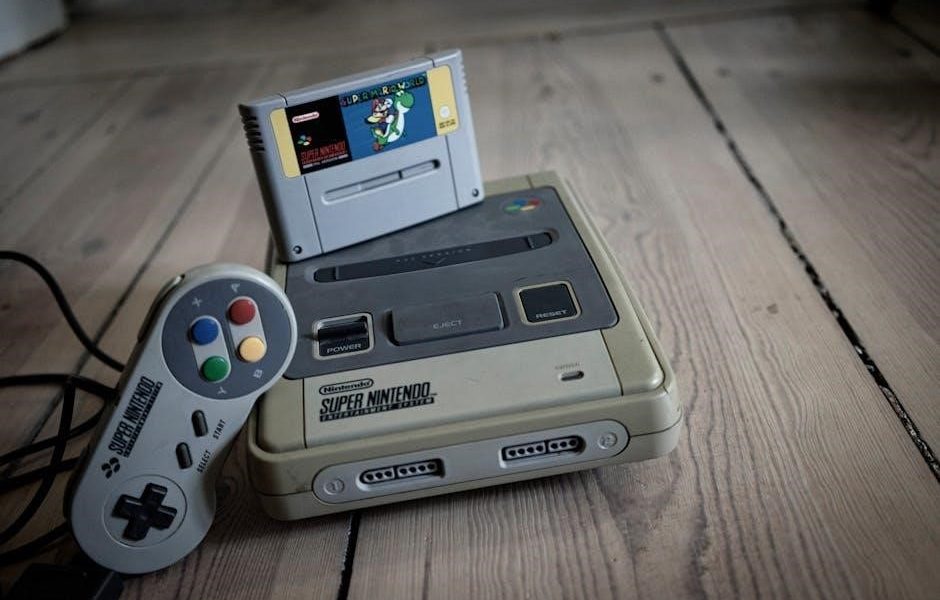
Super Mario World’s SNES manual, a vital companion, offered players a deep dive into the game’s world.
Resources like Peebs SNESManuals.com preserve these historical documents through detailed scans.
Historical Context of the Manual
Super Mario World’s manual debuted alongside the Super Nintendo Entertainment System (SNES) in 1990, representing a shift in game presentation.
Unlike earlier cartridges with minimal documentation, this manual provided extensive details, reflecting the growing complexity of games.
The manual served as a crucial element of the player experience, offering guidance before readily available online resources.
Projects like Peebs SNESManuals.com demonstrate the enduring interest in preserving these pieces of gaming history, offering scans for enthusiasts.
Importance of the Manual for Players
The Super Mario World SNES manual was paramount for players navigating the expansive game world. Before widespread internet access, it detailed Mario’s abilities, Yoshi’s functions, and hidden secrets.
It explained special controls and offered insights into enemy behaviors.
Resources like Peebs SNESManuals.com allow modern players to experience the game as intended, appreciating the manual’s role in discovery and mastery.
Physical Characteristics of the Manual
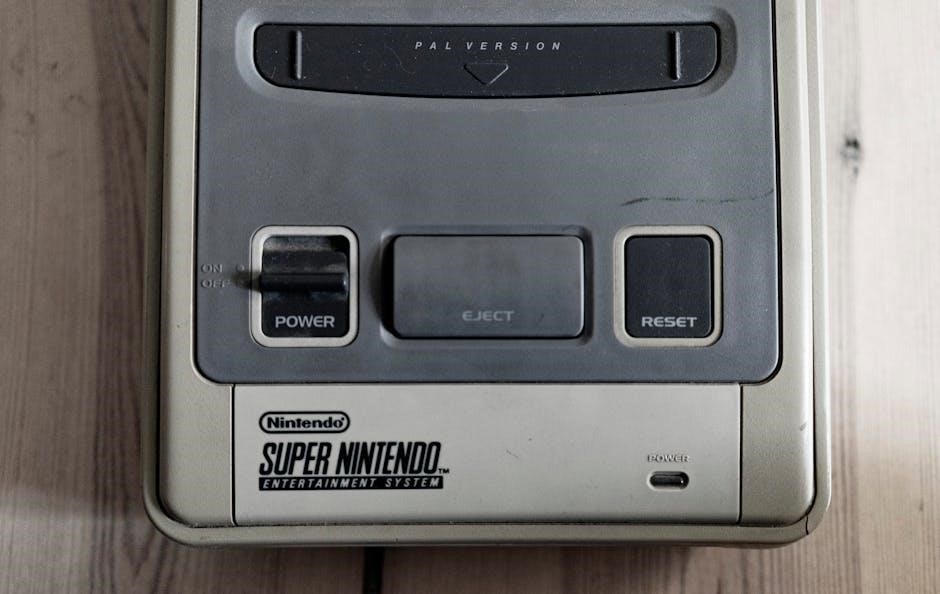
Super Mario World’s SNES manual featured vibrant cover artwork and was printed on standard paper stock for the era. PAL and NTSC versions exhibited slight variations.
Cover Design and Artwork
The Super Mario World SNES manual’s cover is iconic, showcasing Mario riding Yoshi across a colorful landscape. The artwork vividly captures the game’s whimsical and adventurous spirit. It prominently features key characters and elements, instantly recognizable to fans.
The design utilizes bright, saturated colors and dynamic composition, drawing the eye. Different regional releases, like PAL versus NTSC, sometimes presented minor variations in color palettes or layout. The cover’s quality and visual appeal contribute significantly to the manual’s collectibility.
Paper Quality and Dimensions
Super Mario World’s SNES manual utilized a relatively standard paper stock for the era – a lightweight, uncoated paper. This contributed to its susceptibility to wear and tear over time. Typical dimensions are approximately 8.5 x 11 inches, though slight variations may exist.
The paper’s quality wasn’t archival, meaning it yellowed and became brittle with age. PAL and NTSC versions likely shared similar paper stock, but print runs and revisions could introduce subtle differences in texture or weight. Preservation efforts often involve protective sleeves.
Printing Details and Variations (PAL vs. NTSC)
Super Mario World manuals exhibited printing variations between PAL and NTSC regions. NTSC manuals (North America) often featured brighter, more saturated colors, while PAL versions (Europe) sometimes appeared slightly muted. Print runs differed, leading to minor revisions in text or layout.
The printing process itself was standard for the time, utilizing offset lithography. Identifying specific print runs can be challenging, but subtle differences in color registration or paper stock may offer clues. Resources like Peebs SNESManuals.com document these nuances.
Content Overview: A Section-by-Section Breakdown
The Super Mario World manual detailed character profiles, a world map, level overviews, and gameplay mechanics. Scans reveal sections on Mario, Yoshi, and hidden secrets!
Super Mario World’s front cover boldly showcases Mario riding Yoshi, instantly capturing the game’s adventurous spirit. The manual’s introduction warmly welcomes players to Dinosaur Land, setting the stage for a grand rescue mission.
It explains Princess Peach’s abduction by Bowser and his Koopalings, motivating Mario and Luigi to embark on a quest. The introduction highlights the expansive world and the promise of hidden treasures, encouraging exploration. Scans of the manual reveal this initial narrative hook, crucial for player engagement.
Character Profiles: Mario, Luigi, and Yoshi
The Super Mario World manual dedicates sections to profiling Mario, Luigi, and Yoshi. It details Mario’s core abilities – jumping, running, and power-up transformations like Caped Mario and Fire Mario. Luigi is presented as a playable alternative, sharing similar skills.
Crucially, the manual extensively covers Yoshi, explaining his unique abilities and how to effectively utilize him. These character profiles, preserved in scans, were essential for understanding each character’s role and potential within the game.
World Map and Level Overview
The Super Mario World manual features a detailed presentation of the game’s expansive world map. It visually outlines the interconnected levels and pathways, hinting at hidden areas and secret exits. The manual provides a basic overview of each world, preparing players for the challenges ahead.
Players could use this information to strategically plan their journey, seeking out Dragon Coins and unlocking access to Special World and Star World. Scans of the manual reveal these crucial navigational aids.

Gameplay Mechanics Explained in the Manual
Super Mario World’s manual meticulously details Mario’s core controls, power-ups like the Cape Feather, and Yoshi’s unique abilities, enhancing player understanding.
Basic Mario Controls
The Super Mario World manual clearly outlines fundamental controls for navigating the game’s expansive levels. Players learn to utilize the D-pad for movement – left and right for running, and down for crouching.
The ‘A’ button is dedicated to jumping, with jump height determined by how long it’s pressed. ‘B’ initiates running and is crucial for executing spins. The manual emphasizes mastering these special Mario controls for effective gameplay, allowing players to explore and conquer challenges.
Advanced Mario Techniques
The Super Mario World manual hints at techniques beyond basic movement. Mastering the spin jump, achieved by pressing ‘B’ while airborne, allows access to hidden areas and defeating enemies.
Wall kicks, though not explicitly detailed, are implied through level design. The manual stresses increasing Mario’s power through skillful control. Players are encouraged to search levels thoroughly to unlock the full potential of these advanced maneuvers, enhancing their overall gaming experience.
Power-Ups: Super Mushroom, Fire Flower, Cape Feather
The Super Mario World manual meticulously details each power-up. The Super Mushroom restores Mario to full size after damage. The Fire Flower grants the ability to throw fireballs, defeating enemies from a distance.
Most notably, the Cape Feather transforms Mario, enabling flight and a gliding descent. The manual emphasizes utilizing these powers strategically, showcasing how each enhances Mario’s abilities and unlocks new gameplay possibilities throughout the adventure.
Yoshi’s Abilities and Usage
The Super Mario World manual dedicates significant space to Yoshi, highlighting his unique abilities; Yoshi can flutter jump, providing extended air time, and swallow enemies. Swallowed enemies can then be expelled as projectiles.
The manual explains how Mario can ride Yoshi, utilizing his tongue to interact with the environment. It also details obtaining and maintaining Yoshi, emphasizing the importance of Yoshi Cookies for keeping him from departing.
Secret Areas and Hidden Items
Super Mario World’s manual hints at hidden levels, Dragon Coins, and secret exits. Players are encouraged to search thoroughly to uncover these treasures within the game!
Finding Secret Exits
Super Mario World’s manual subtly guides players toward discovering hidden exits within levels. These aren’t explicitly marked, demanding careful exploration and experimentation. The manual emphasizes the need to search all areas, hinting that seemingly ordinary blocks or walls might conceal pathways.
Finding these secret exits often unlocks access to Special World or Star World, offering new challenges and rewards. The manual doesn’t reveal locations directly, fostering a sense of discovery and encouraging players to meticulously investigate each stage for concealed routes.
Locating Dragon Coins
The Super Mario World manual briefly mentions the existence of Dragon Coins, but provides minimal guidance on their locations. It states players will need to search diligently throughout the game’s levels to uncover these hidden collectibles. The manual emphasizes that finding all Dragon Coins is a significant accomplishment,
unlocking a special reward. While not detailing specific hiding spots, the manual implicitly encourages thorough exploration and a keen eye for detail. Discovering these coins adds a layer of challenge and completionism for dedicated players.
Discovering Hidden Levels
The Super Mario World manual hints at the presence of secret levels, accessible through cleverly concealed exits within existing stages. It encourages players to meticulously search each level, looking for unusual blocks, hidden passages, and subtle clues indicating alternate routes.
The manual doesn’t explicitly reveal these secrets, instead fostering a sense of discovery and rewarding exploration. Finding these hidden levels expands the game’s content and provides a greater challenge for experienced players, adding replayability.

Special World and Star World Access
Super Mario World’s manual details unlocking the Special and Star Worlds, requiring players to find hidden Star Road locations and complete specific levels.
Requirements for Unlocking Special World
The Super Mario World manual explains accessing the Special World necessitates discovering secret exits within specific levels. Players must locate the hidden goal in Donut Plains 1, finding a path leading to a new area.
Successfully completing this challenge unlocks the Special World, presenting a significantly increased difficulty and unique level design. The manual serves as a guide, hinting at the exploration needed to uncover these secrets, encouraging thorough searching of each stage.
Requirements for Unlocking Star World
The Super Mario World manual details that unlocking Star World requires finding all five Star Road locations scattered throughout the game’s various worlds. These hidden paths are accessed by discovering secret exits within levels like Donut Plains 2, Vanilla Dome 1, and Twin Bridges Area.
The manual guides players to diligently explore, hinting at the rewards awaiting those who uncover these concealed routes. Successfully finding all Star Roads grants access to the challenging Star World.
Enemies and Bosses
The manual details common enemies and their behaviors, alongside strategies for defeating bosses.
Understanding enemy patterns is key to success in Super Mario World!
Common Enemies and Their Behaviors
The Super Mario World manual meticulously outlines the behaviors of numerous enemies encountered throughout the game. Koopa Troopas, for example, are described as walking shells, vulnerable when flipped onto their backs. Goombas, the most basic enemy, simply walk forward and are easily defeated.
The manual also details more complex enemies like Spinies, which are covered in spikes, and Boo’s, who chase Mario when he isn’t looking. Understanding these behaviors, as presented in the manual, is crucial for navigating levels effectively and avoiding unnecessary damage.
Boss Strategies and Weaknesses
The Super Mario World manual provides limited, yet helpful, insights into defeating the game’s bosses. While not offering exhaustive strategies, it hints at their weaknesses. Reznor, for instance, is vulnerable when his shell is exposed after removing the blocks supporting him.
The manual suggests observing boss patterns and utilizing precise jumps and power-ups. It doesn’t detail specific timing, encouraging players to experiment and learn through gameplay. Ultimately, mastering these bosses relies on player skill and applying the manual’s basic guidance.
Items and Their Functions
The SNES manual details key items like the Cape Feather, Fire Flower, and Yoshi Cookie.
It explains how each enhances Mario’s abilities, aiding exploration and combat within the game’s vibrant world.
Cape Feather Details
The Super Mario World manual thoroughly explains the Cape Feather’s transformative power. Upon acquisition, Mario gains the ability to glide and fly, opening up previously inaccessible areas and offering strategic advantages.
The manual illustrates how to utilize the cape for controlled descents and sustained flight, emphasizing timing and directional control. It also details the cape’s defensive capability – a mid-air spin that deflects enemy attacks. Mastering the cape is crucial for discovering hidden secrets and completing challenging levels, as highlighted within the SNES guide.
Fire Flower Details
The Super Mario World manual dedicates space to explaining the Fire Flower’s function, transforming Mario into Fire Mario. This upgrade grants the ability to launch fireballs, effectively eliminating enemies from a distance and solving environmental puzzles.
The guide details how to aim and fire these projectiles, emphasizing strategic use against specific enemy types. It also notes the Fire Flower’s temporary nature, requiring players to seek out additional power-ups. SNES players relied on the manual to fully understand this potent ability.
Yoshi Cookie Information
The Super Mario World manual clearly explains the purpose of Yoshi Cookies: to replenish Yoshi’s hunger. If Yoshi is left unattended for too long, or consumes too many enemies, he will disappear!
The manual illustrates how these cookies are found throughout the game, often hidden in blocks or awarded for completing levels. It stresses the importance of keeping Yoshi fed to maintain his assistance, highlighting this unique gameplay element. SNES players depended on this information for successful gameplay.

The Role of Yoshi
The manual details Yoshi’s abilities, like fluttering and eating enemies. It explains how to obtain and maintain Yoshi, emphasizing the importance of Yoshi Cookies for survival!
Yoshi’s Different Abilities
The Super Mario World manual meticulously outlines Yoshi’s diverse skillset. Beyond simply carrying Mario, Yoshi can flutter jump, granting access to previously unreachable areas. He possesses a powerful tongue for capturing enemies, and swallowing them often yields helpful items or abilities.
Furthermore, the manual details how Yoshi can gain wings with a feather, enabling extended flight. It also explains how Yoshi’s color changes based on the shell he eats, impacting his abilities. Understanding these nuances, as presented in the manual, is crucial for mastering the game.
How to Obtain and Maintain Yoshi
The Super Mario World manual clearly explains Yoshi acquisition – finding a blue Yoshi Egg hidden throughout the levels. Once hatched, Yoshi becomes Mario’s loyal companion. However, maintaining Yoshi requires careful play.
The manual warns that Yoshi is easily lost; a single hit from an enemy will cause him to flee. Players must protect Yoshi to continue benefiting from his abilities. It also details how Yoshi can be remounted after being temporarily defeated, emphasizing strategic gameplay.
Scanning and Digital Preservation
Super Mario World’s manual benefits from digital preservation efforts. Projects like Peebs SNESManuals.com provide high-quality scans, ensuring accessibility for future generations of gamers.
Resources for Finding Scanned Manuals (Peebs SNESManuals.com)
Peebs SNESManuals.com stands as an invaluable resource for enthusiasts seeking digital copies of the Super Mario World manual and countless others. This dedicated project meticulously collects and provides high-resolution scans of original SNES game manuals.
The site offers a user-friendly interface for browsing and downloading these preserved pieces of gaming history. Beyond Peebs, exploring communities like Internet Archive can also yield fruitful results, though the scan quality may vary. These digital archives ensure the longevity of these manuals.
Digital Formats and Accessibility
Super Mario World SNES manuals, once solely physical, are now widely available in digital formats like PDF and image files (JPG, PNG). These formats enhance accessibility, allowing players to view the manual on various devices – computers, tablets, and smartphones.
Quality of Scans and Image Resolution
The quality of Super Mario World SNES manual scans varies considerably. High-resolution scans, crucial for readability, capture details like artwork and text clearly. Lower resolution scans may appear pixelated or blurry, hindering comprehension.
Projects like Peebs SNESManuals.com strive for optimal quality, but scan quality depends on the original manual’s condition and the scanning equipment used. Clear, well-lit scans preserve the manual’s historical integrity and enhance the user experience.
Manual Variations and Regional Differences
Super Mario World manuals exhibit variations between PAL and NTSC regions, impacting content and language. Different print runs also show minor revisions over time.
PAL vs. NTSC Manual Content
Super Mario World SNES manuals differed significantly between PAL (European) and NTSC (North American/Japanese) releases. The PAL manual, designated SNSP-MW-NOE-1, often included translated text and adjusted content to suit regional preferences.
These variations extended to artwork and layout, reflecting differing marketing strategies. While core gameplay information remained consistent, subtle changes in wording and presentation were common. Collectors often seek both versions to appreciate these nuances, highlighting the game’s global appeal and regional adaptations.
Different Print Runs and Revisions
Super Mario World SNES manuals experienced multiple print runs, leading to subtle revisions over time. Early printings might contain minor errors or inconsistencies later corrected by Nintendo. These changes could involve typos, updated legal information, or slight alterations to artwork.
Identifying these variations is a key pursuit for collectors, as first-edition manuals often command higher values. Examining print dates and comparing details against known revisions helps determine a manual’s rarity and historical significance within the game’s lifecycle.

Collecting and Preserving the Manual
Super Mario World manuals are prized collectibles; condition significantly impacts value. Protecting them from damage—using sleeves and careful storage—is crucial for preservation and investment.
Condition and Grading
Super Mario World SNES manual grading assesses its physical state, impacting collector value. Key factors include spine integrity, corner sharpness, and presence of creases or tears.
A pristine, uncreased manual with a tight spine commands a premium. Minor wear lowers the grade, while significant damage drastically reduces worth. Collectors often use a 1-10 scale, with 10 being flawless.
Resources detailing grading standards help accurately assess a manual’s condition, ensuring fair transactions within the collecting community. Careful examination is essential!
Protecting the Manual from Damage
Preserving your Super Mario World SNES manual requires proactive measures. Avoid direct sunlight, which fades colors and weakens paper. Store it in a cool, dry place, away from humidity and temperature fluctuations.
Acid-free plastic sleeves or mylar bags offer excellent protection against dust, fingerprints, and tears. Avoid PVC sleeves, as they can damage the paper over time. Handle the manual with clean hands, and never write on it!
Proper storage safeguards this piece of gaming history for future generations.
Value and Rarity
The value of a Super Mario World SNES manual fluctuates based on condition and regional variation. Pristine, uncreased copies command higher prices among collectors. PAL versions often differ in content and can be rarer than NTSC editions.
Grading services assess condition, impacting market value. Complete manuals, including inserts, are more desirable. Demand from retro gaming enthusiasts drives prices upward, making preservation a worthwhile investment.
Condition is paramount when determining the monetary worth of this collectible.

Troubleshooting and FAQs from the Manual
Super Mario World’s manual addressed common issues like controller configuration and gameplay hiccups. It provided basic solutions for players encountering problems during their adventure.
Common Gameplay Issues
Super Mario World’s manual acknowledged potential player frustrations. It offered guidance for navigating tricky sections and understanding game mechanics. Issues included difficulty finding secret exits, mastering Mario’s advanced controls, and effectively utilizing Yoshi’s abilities.
The manual also touched upon problems with item usage, like the Cape Feather, and understanding enemy behaviors. Players could reference it for solutions to common stumbling blocks encountered throughout the expansive game world, enhancing their overall experience.
Controller Configuration
Super Mario World’s SNES manual provided a clear diagram illustrating the standard SNES controller layout. It detailed each button’s function – jump, run, fire, and the shoulder buttons for Yoshi’s abilities.
The manual confirmed compatibility with standard SNES controllers, ensuring players understood the basic setup. While not extensively detailed, it served as a quick reference for newcomers unfamiliar with the console’s controls, facilitating a smooth and enjoyable gaming experience.
The Manual as a Piece of Gaming History
Super Mario World’s manual embodies the SNES era, enhancing player immersion. Scans preserve its significance, showcasing a tangible link to gaming’s past and player experience.
Its Significance in SNES Era
Super Mario World’s manual wasn’t merely an instruction booklet; it was a portal into the game’s vibrant world during the SNES’s golden age. Before widespread internet access, the manual served as the primary source of information, guiding players through its secrets.
Detailed artwork and character profiles fueled imagination, while level overviews sparked exploration. The manual’s physical presence—its paper quality and cover design—contributed to the overall gaming experience. Preserved through projects like Peebs SNESManuals.com, these scans offer a nostalgic glimpse into a pivotal moment in gaming history.
Impact on Player Experience
The Super Mario World SNES manual profoundly shaped the player experience, fostering a sense of discovery and community. Without readily available online guides, players relied on the manual to unravel secrets like hidden levels and Dragon Coins.
Understanding Mario’s controls and Yoshi’s abilities, detailed within its pages, was crucial for progression. The manual’s artwork ignited imagination, while troubleshooting tips aided those facing gameplay issues. Digital preservation efforts, like those on Peebs SNESManuals.com, ensure this impact endures.